The Nonprofit Leader All-Rounder 360 is our in-depth 360 feedback survey for nonprofit leaders, and our one deliberately long survey: 72 rated questions across 15 areas, including beneficiary focus, partnerships and shared leadership, plus 2 open questions. Inspired by the work of Marshall Goldsmith.
- Who it's for
- Nonprofit and civil society leaders, boards and HR teams who want feedback tools they can afford.
- Length
- 74 questions, about 30 minutes per respondent
- What you get
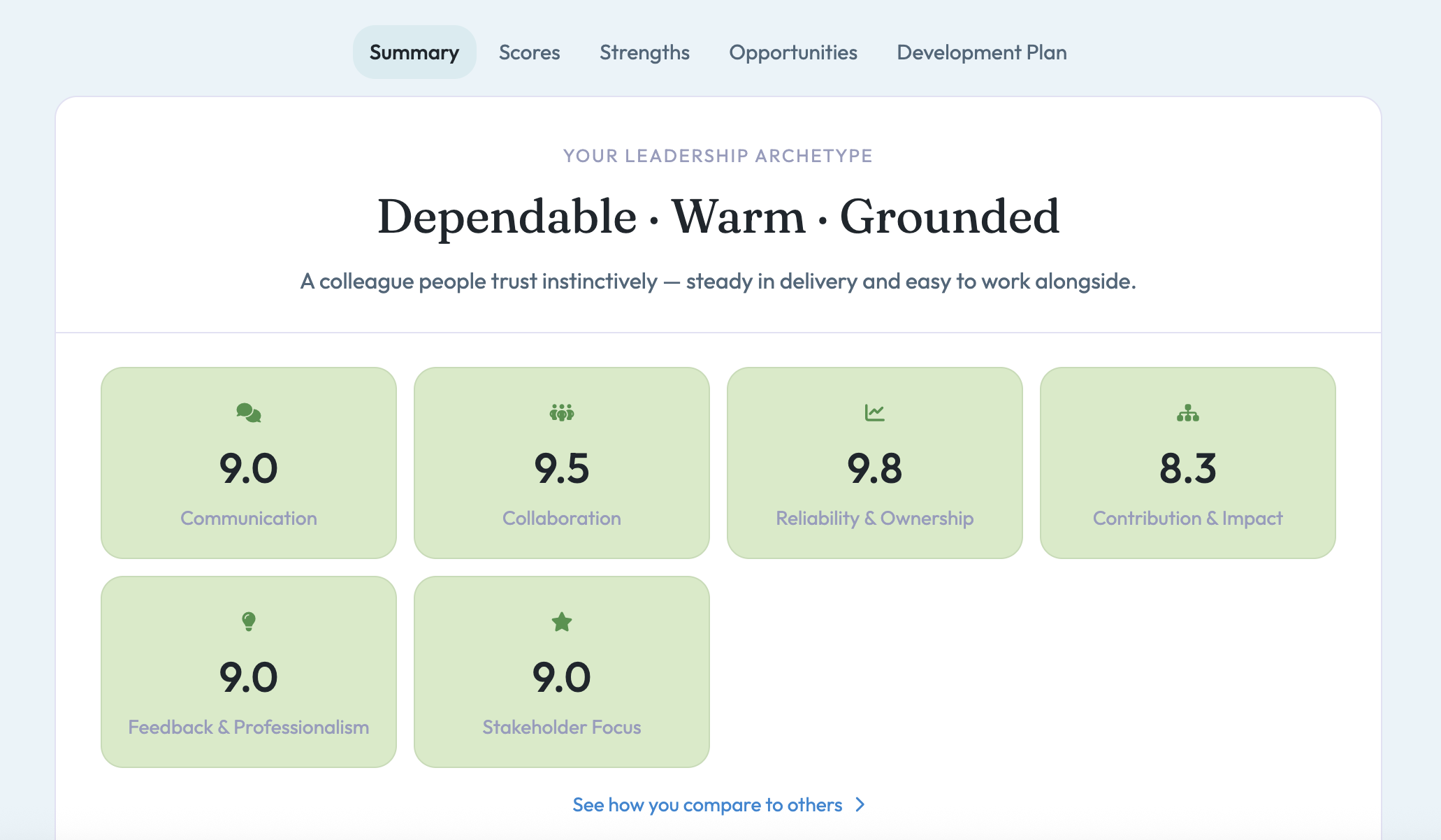
- An AI-written report with scores, strengths, growth areas and a development plan. See a sample report
The 74 questions in this survey
Thinking Globally
- 1.1Recognizes the impact of globalization on our mission(likert)
- 1.2Demonstrates the adaptability required to succeed in the global environment(likert)
- 1.3Strives to gain the variety of experiences needed to have a global impact(likert)
- 1.4Makes decisions that incorporate global considerations(likert)
- 1.5Helps others understand the impact of globalization(likert)
Appreciating Diversity
- 2.1Embraces the value of diversity in people (including culture, race, sex, or age)(likert)
- 2.2Effectively motivates people from different cultures or backgrounds(likert)
- 2.3Recognizes the value of diverse views and opinions(likert)
- 2.4Helps others appreciate the value of diversity(likert)
- 2.5Actively expands their knowledge of other cultures (through interactions, language study, travel, etc.)(likert)
Developing Technological Savvy
- 3.1Strives to acquire the technological knowledge needed to succeed in tomorrow's world(likert)
- 3.2Successfully recruits people with needed technological expertise(likert)
- 3.3Effectively manages the issue of technology to increase productivity(likert)
Building Partnerships
- 4.1Treats coworkers as partners, not competitors(likert)
- 4.2Unites their organization into an effective team(likert)
- 4.3Builds effective partnerships across the company(likert)
- 4.4Discourages destructive comments about other people or groups(likert)
- 4.5Builds effective alliances with other organizations(likert)
- 4.6Creates a network of relationships that help to get things done(likert)
Sharing Leadership
- 5.1Willingly shares leadership with colleagues(likert)
- 5.2Defers to others when they have more expertise(likert)
- 5.3Strives to arrive at an outcome with others (as opposed to for others)(likert)
- 5.4Creates an environment where people focus on the larger good (avoids sub-optimization or "turfism")(likert)
Creating a Shared Vision
- 6.1Creates and communicates a clear vision for our organization(likert)
- 6.2Effectively involves people in decision-making(likert)
- 6.3Inspires people to commit to achieving the vision(likert)
- 6.4Develops an effective strategy to achieve the vision(likert)
- 6.5Clearly identifies priorities(likert)
Developing People
- 7.1Consistently treats people with dignity(likert)
- 7.2Asks people what they need to do their work better(likert)
- 7.3Ensures that people receive the training they need to succeed(likert)
- 7.4Provides effective coaching(likert)
- 7.5Provides developmental feedback in a timely manner(likert)
- 7.6Provides effective recognition for others' achievements(likert)
Empowering People
- 8.1Builds people's confidence(likert)
- 8.2Takes risks in letting others make decisions(likert)
- 8.3Gives people the freedom they need to do their job well(likert)
- 8.4Trusts people enough to let go (avoids micromanagement)(likert)
Achieving Personal Mastery
- 9.1Deeply understands their own strengths and weaknesses(likert)
- 9.2Invests in ongoing personal development(likert)
- 9.3Involves people who have strengths that they do not possess(likert)
- 9.4Demonstrates effective emotional responses in a variety of situations(likert)
- 9.5Demonstrates self-confidence as a leader(likert)
Encouraging Constructive Dialogue
- 10.1Asks people what they can do to improve(likert)
- 10.2Genuinely listens to others(likert)
- 10.3Accepts constructive feedback in a positive manner (avoids defensiveness)(likert)
- 10.4Strives to understand the other person's frame of reference(likert)
- 10.5Encourages people to challenge the status quo(likert)
Demonstrating Integrity
- 11.1Demonstrates honest, ethical behavior in all interactions(likert)
- 11.2Ensures that the highest standards for ethical behavior are practiced throughout the organization(likert)
- 11.3Avoids political or self-serving behavior(likert)
- 11.4Courageously stands up for what they believe in(likert)
- 11.5Is a role model for living our organization's values (leads by example)(likert)
Leading Change
- 12.1Sees change as an opportunity, not a problem(likert)
- 12.2Challenges the system when change is needed(likert)
- 12.3Thrives in ambiguous situations (demonstrates flexibility when needed)(likert)
- 12.4Encourages creativity and innovation in others(likert)
- 12.5Effectively translates creative ideas into results(likert)
Anticipating Opportunities
- 13.1Invests in learning about future trends(likert)
- 13.2Effectively anticipates future opportunities(likert)
- 13.3Inspires people to focus on future opportunities (not just present objectives)(likert)
- 13.4Develops ideas to meet the needs of the new environment(likert)
Ensuring Beneficiary Satisfaction
- 14.1Inspires people to achieve high levels of beneficiary satisfaction(likert)
- 14.2Views business processes from the ultimate beneficiary perspective (has an "end to end" perspective)(likert)
- 14.3Regularly solicits input from beneficiaries and funders(likert)
- 14.4Consistently delivers on commitments to beneficiaries and funders(likert)
- 14.5Understands the options for beneficiaries provided by peer organizations(likert)
Ensuring Relevance and Quality
- 15.1Communicates a positive, "can do" sense of urgency toward getting the job done(likert)
- 15.2Holds people accountable for their results(likert)
- 15.3Successfully eliminates waste and unneeded cost(likert)
- 15.4Provides products/services that offer a clear benefit in comparison to those provided by peer organizations(likert)
- 15.5Achieves results that lead to long-term impact(likert)
Written Comments
- 16.1What does this person do that you particularly appreciate? (Please list two or three specific items.)
- 16.2What suggestions would you have for this person on how they could become even more effective? (Please list two or three specific items).