
Traditional leadership 360s grew up in big organizations. They emphasize generic behaviors like “manages processes effectively” or “supports HR initiatives,” which matter in a mature company but barely touch the real failure modes of an early‑stage startup.Founders face a different game:
- You’re leading in extreme uncertainty, with incomplete data and brutal time pressure.
- Your decisions on vision, cash, hiring and investors can kill or save the company in months, not years.
- You’re being judged not only by your team but also by customers, advisors, and investors in every interaction.
Research on startup leadership shows that founders consistently rate vision, strategy, and decision‑making as critical while still needing strong interpersonal and cognitive skills to keep people aligned aligned in a highly dynamic environment.Likewise, investors explicitly look for behaviors like the ones below, when backing a founder.Yet most 360s never ask about those things.
- Command of key metrics and business drivers
- Intellectual honesty about risks and gaps
- Evidence of real customer insight and obsession
- Strategic clarity about trade‑offs and path to scale
- Composure, coachability and decisive communication under pressure
That’s why we built a founder‑specific leadership model and 360 survey: to reflect the actual competencies that drive startup survival, growth, and investor confidence.
Who this 360 is for?
This Startup Founder 360 is designed for:
- Founders and co‑founders of tech and product‑led startups, typically from pre‑seed through Series B.
- Founding CEOs who have never had formal leadership development but suddenly find themselves leading teams, boards and investors.
- Incubator and accelerator programs that want a structured way to give founders behavioral feedback instead of vague “be more strategic” advice.
- Boards, investors and advisors who want a constructive, data‑driven way to support a founder’s growth rather than relying on anecdotes.
It works best when the founder has at least a small team (e.g., 4–5 people) and some investor or advisory relationships, so there are multiple perspectives to include.When to use itGood moments to run this 360 include:
- After the first year of building, when the founder has hired an initial team and raised (or attempted) a round.
- Before or after a major milestone: raising a new round, entering a new market, or adding senior leadership.
- As part of an accelerator or portfolio support program, combined with coaching and a simple development.
Our competency model for founders
We distilled ten founder‑specific competencies in five groups that map to the real jobs of a startup CEO: setting vision, learning from customers, building a small but mighty team, running the business, managing self, and working effectively with boards and investors.
1. Vision & Product Strategy
Purpose: Can this founder see around corners and turn that into a coherent, communicable direction.
Core competencies:
- Visionary thinking: Anticipates where the market is going, not just where it is today; articulates a compelling “why now / why us.”
- Strategic focus: Chooses a clear strategic lane (segment, wedge, GTM) and sticks with it long enough to learn, instead of constant thrash.
- Prioritization under uncertainty: Makes explicit trade‑offs (what we won’t do), avoids distraction by shiny objects.
Example behaviors to rate:
- “Paints a clear, energizing picture of where the company is heading in 2–3 years.”
- “Says ‘no’ to attractive but distracting opportunities that don’t fit our strategy.”
2. Customer & Market Orientation
Purpose: Avoid “building in a vacuum” and catch opportunity early.
Core competencies:
- Customer discovery: Systematically seeks to understand customer problems, not just pitch the solution.
- Customer‑centric decisions: Uses customer impact as a key filter in product and roadmap decisions.
- Competitive/market awareness: Tracks key competitors and substitutes, understands why customers choose or leave you.
Example behaviors:
- “Regularly talks to customers or prospects and brings those insights back to the team.”
- “Connects day‑to‑day priorities to solving specific customer problems.”
3. People & Culture Leadership
Purpose: Reduce burnout, chaos and attrition by improving how the founder leads humans, not just product.
Core competencies:
- Talent magnet & partner: Attracts strong people, partners effectively, does not play the hero or lone wolf.
- Expectations & feedback: Sets clear goals, roles and success metrics; gives candid, timely feedback (up, down, sideways).
- Coaching & development: Invests time in growing key people, not just delegating tasks.
- Culture shaping: Models the desired norms (ownership, transparency, psychological safety, pace) and calls out misalignment early.
Example behaviors:
- “Defines what ‘good’ looks like for people’s roles and holds them to it without micromanaging.”
- “Creates an environment where people can raise concerns and mistakes without fear of blame.”
4. Execution & Operating Discipline
Purpose: Avoid “busy chaos” and cash‑burn by building a minimum viable operating system.
Core competencies:
- Goal setting & cadence: Uses simple, lightweight planning (e.g., OKRs or equivalents) and a predictable weekly rhythm.
- Decision‑making speed & quality: Makes decisions with incomplete information, revisits them when new data appears instead of sticking to ego.
- Resource & financial discipline: Understands burn, runway, unit economics at a practical level; aligns spending with milestones.
- Delegation & scaling self: Delegates outcomes (not tasks), builds systems so the company can operate without the founder in every loop.
Example behaviors:
- “Makes timely decisions and is willing to reverse them when evidence suggests a better path.”
- “Understands and regularly communicates our cash runway and key financial levers.”
5. Self‑Leadership & Learning Agility
Purpose: Early‑stage founders are the main bottleneck; their self‑management determines everyone else’s experience.
Core competencies:
- Self‑awareness & coachability: Actively seeks feedback, acknowledges mistakes, adjusts behavior; doesn’t get defensive with investors or team.
- Resilience & emotional regulation: Stays steady under pressure, doesn’t transmit panic, but is honest about risks.
- Continuous learning: Proactively builds new skills (fundraising, hiring, product, leadership) instead of relying only on what got them here.
- Personal sustainability: Sets realistic pace, manages energy, and avoids creating chronic fire‑drill culture.
Example behaviors:
- “Responds constructively when challenged, using criticism to improve decisions.”
- “Maintains composure during setbacks and helps the team focus on solutions.”
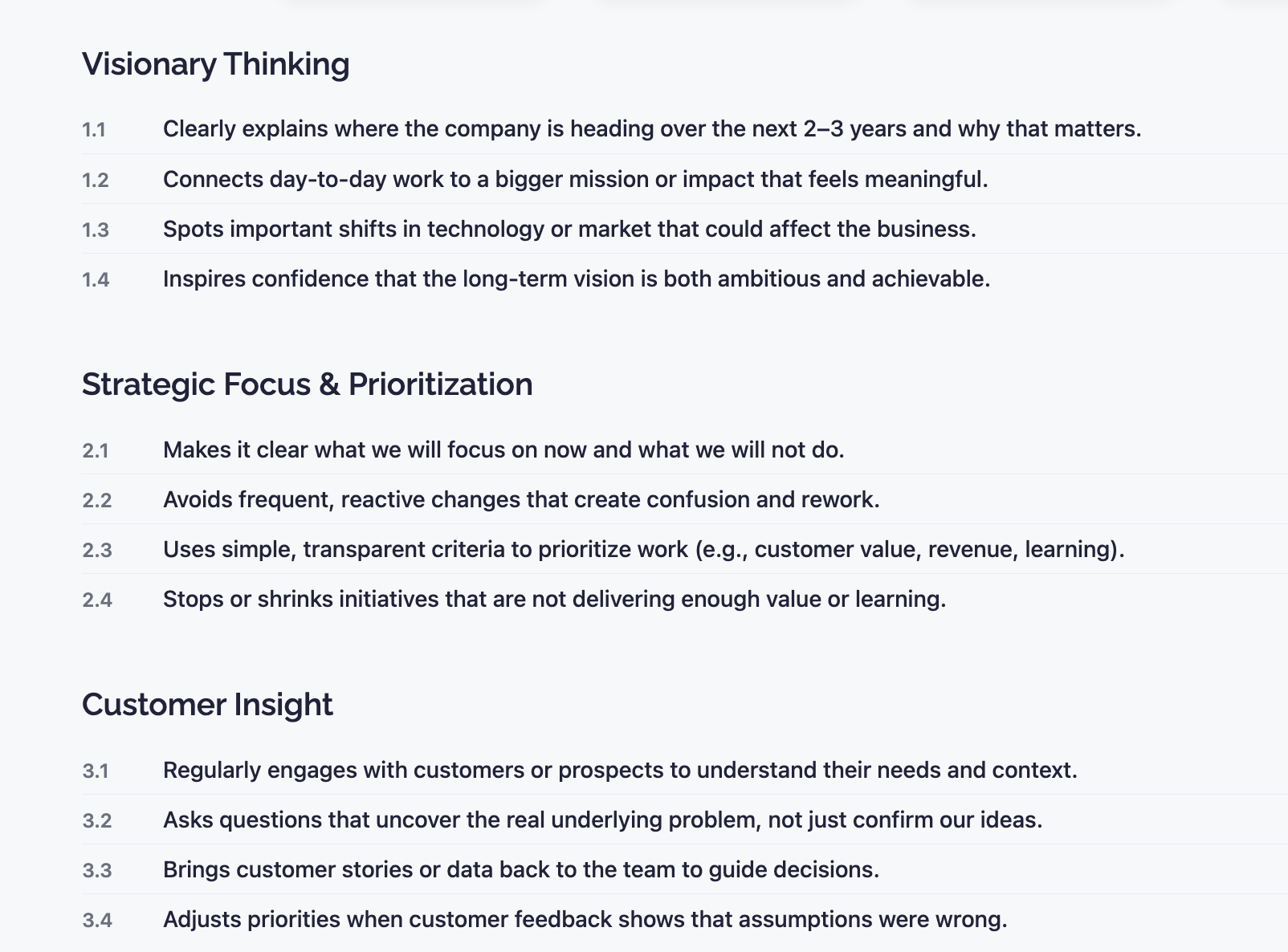
We translated this competency model into a focused 360° assessment with 40 rating-scale questions and 4 open-ended questions, designed to deliver high-quality insights without overloading respondents.
See the extract below.
Ready to Get Started?
Take Our Startup Founders Leadership 360 Assessment
Transform your leadership impact with feedback designed specifically for healthcare environments. Our founder-specific 360 assessment gives you the insights you need to strengthen patient care, support your team, and advance your leadership effectiveness.
Start Your Startup Founders Leadership 360 Assessment Now →
Questions about the process? Need support with your development plan? Contact our team for guidance tailored to healthcare leadership challenges.
Recommended reading:
- Forbes Business Council. (2024, September 13). Nine key leadership traits for tech founders. Forbes.
- Pavlov, E. (2025, October 17). Culture and leadership in startups: Lessons from the founder. Hackernoon.
- Powderkeg. (n.d.). Developing your leadership style: A startup executive’s guide. Powderkeg.
- The Clueless Company. (n.d.). 5 leadership qualities a successful startup founder must have. The Clueless Company.
- Vezetéstudomány / Budapest Management Review. (2022). The four leadership styles of entrepreneurs: A competency-based model for entrepreneurial leadership. Vezetéstudomány / Budapest Management Review, 53(5), 16–31.