
Healthcare runs on teams, not heroes. Yet many clinicians are asked to step into leadership roles—with huge responsibility for patients and staff—without ever getting feedback on how they’re actually leading. Generic corporate tools don’t quite fit the realities of wards, clinics, and community services.
That’s why a medical‑specific 360‑degree leadership survey is so valuable. Leadership in health and care is different from leadership in most other sectors. A few reasons:
- Patient safety and outcomes are at stake in everyday decisions.
- Teams are naturally multidisciplinary: physicians, nurses, AHPs, pharmacists, social workers, admin, managers.
- Work happens under high emotional load, heavy regulation, and chronic pressure on capacity and budgets.
- Many leaders hold dual roles: they’re still clinicians and service leads, clinical directors, nurse managers, or department heads.
A generic corporate 360 might ask whether you “drive sales,” “manage budgets,” or “support HR initiatives.” Those questions barely touch the lived reality of:
- A consultant leading an acute medical unit.
- A GP partner steering a primary care network.
- A senior nurse managing an ICU or theatre team.
- An allied health professional leading rehabilitation services.
- A clinical manager coordinating outpatient clinics across several sites.
The health/medical 360 is designed for this diversity of roles. It works for:
- Physicians (consultants, attendings, residents with leadership responsibilities, medical directors).
- Nurse leaders (charge nurses, ward sisters, matrons, DONs, CNS/NP leaders).
- Allied health professionals (physiotherapy, occupational therapy, pharmacy, radiography leaders).
- Service and department managers working closely with clinical teams.
- Leaders in hospitals, primary care, community services, mental health, and integrated care systems.
The underlying competencies stay the same, but the wording is role‑neutral so everyone can see themselves in it.
The competency model: what “good” medical leadership looks like
The model behind this 360 is built around five clusters and nine competencies that show up consistently in effective medical and clinical leadership.
1. Personal Qualities & Professionalism
Ethical Practice & Integrity: Medical leaders are custodians of professional standards. This competency focuses on acting in line with professional and organizational values, consistently putting patient safety and wellbeing first, being open and honest when things go wrong, and treating patients, families, and colleagues with fairness and respect.
Self‑Awareness & Resilience: Clinical work is emotionally and cognitively demanding; leadership adds another layer. Here the focus is on asking for and listening to feedback, recognizing signs of stress or overload, staying calm and thoughtful in high‑pressure situations, and setting realistic limits on workload to remain effective and safe over time.
What’s unique to health: professionalism and personal resilience are directly tied to safe care and role‑modelling for trainees and junior staff. This goes beyond generic “emotional intelligence” into the specifics of clinical responsibility.
2. Clinical Credibility & System Literacy
Clinical Credibility & Evidence‑Informed Practice: Medical leaders need enough clinical insight to be trusted by those they lead. This doesn’t mean being the most senior clinician in every room; it means maintaining up‑to‑date knowledge in their field, using guidelines and evidence when shaping care, understanding frontline realities, and being seen as a credible clinical voice.
Understanding How the System Works: Care happens within complex systems: pathways, commissioning, quality standards, inspection regimes, digital systems, population health needs. This competency looks at whether the leader understands how their service fits into wider patient journeys, knows relevant quality and safety requirements, uses data when making decisions, and thinks about access and fairness for different patient groups.
What’s unique to health: the combination of clinical credibility plus system literacy is particular to healthcare. Leaders must bridge bedside and boardroom rather than living only in one world.
3. Working with Others & Communication
Working Across Professions: Healthcare is inherently interprofessional. This competency focuses on building positive relationships across roles, involving the right people in decisions that affect patients or services, handling disagreements respectfully, and valuing the contributions of all staff groups.
Communication & Interpersonal Style: Clinical leaders communicate with patients, families, colleagues, managers, and external partners. Here we look at explaining information clearly in everyday language, listening and checking understanding, adapting style to different audiences, and creating an environment where people feel able to speak up about concerns, including safety issues.
What’s unique to health: leading across professional boundaries and hierarchies is part of the job description. Communication is not just about “influencing”; it’s about enabling safe, coordinated care.
4. Managing & Improving Services
Managing Day‑to‑Day Services: This competency is about making care work reliably on the ground: planning and organizing work so care is safe and timely, anticipating and responding to changes in demand or staffing, using limited resources wisely, and escalating risks appropriately when safety or quality is at stake.
Improving Quality and Safety: Here the focus is on creating a culture where incidents and near‑misses are reported and learned from; using audits, outcome data, complaints and compliments to spot improvement opportunities; involving frontline staff in practical problem‑solving; and following through on agreed changes to see if they actually work.
What’s unique to health: quality and safety are central outcomes, not side metrics. The 360 doesn’t just ask if leaders “manage operations”; it asks if they improve care.
5. Setting Direction & Leading Change
Vision, Direction & Change Healthcare is under constant pressure to change—new pathways, digital tools, integrated care models, shifting population needs. This competency looks at whether leaders can describe what good care should look like, align local goals with wider priorities, explain why changes are needed, and guide staff through change while keeping care safe and morale intact.
What’s unique to health: change often happens in live, high‑stakes environments where services cannot simply be “paused.” Leaders must balance ambition with safety and staff wellbeing.
Our medical‑specific 360, built on competencies like the ones above, changes that. It lets:
- Physician leaders see how colleagues experience their balance of clinical credibility, communication, quality focus and system thinking.
- Nurse and AHP leaders understand how well they’re supporting interprofessional teams, managing day‑to‑day services, and driving improvement.
- Service managers working with clinical teams get clear feedback on how effectively they’re connecting operational demands with clinical priorities.
- Organizations spot leadership strengths and gaps that actually matter for patient care, staff wellbeing, and service performance.
We translated this competency model into a focused 360° assessment with 40 rating-scale questions and 4 open-ended questions, designed to deliver high-quality insights without overloading respondents.
See the extract below.
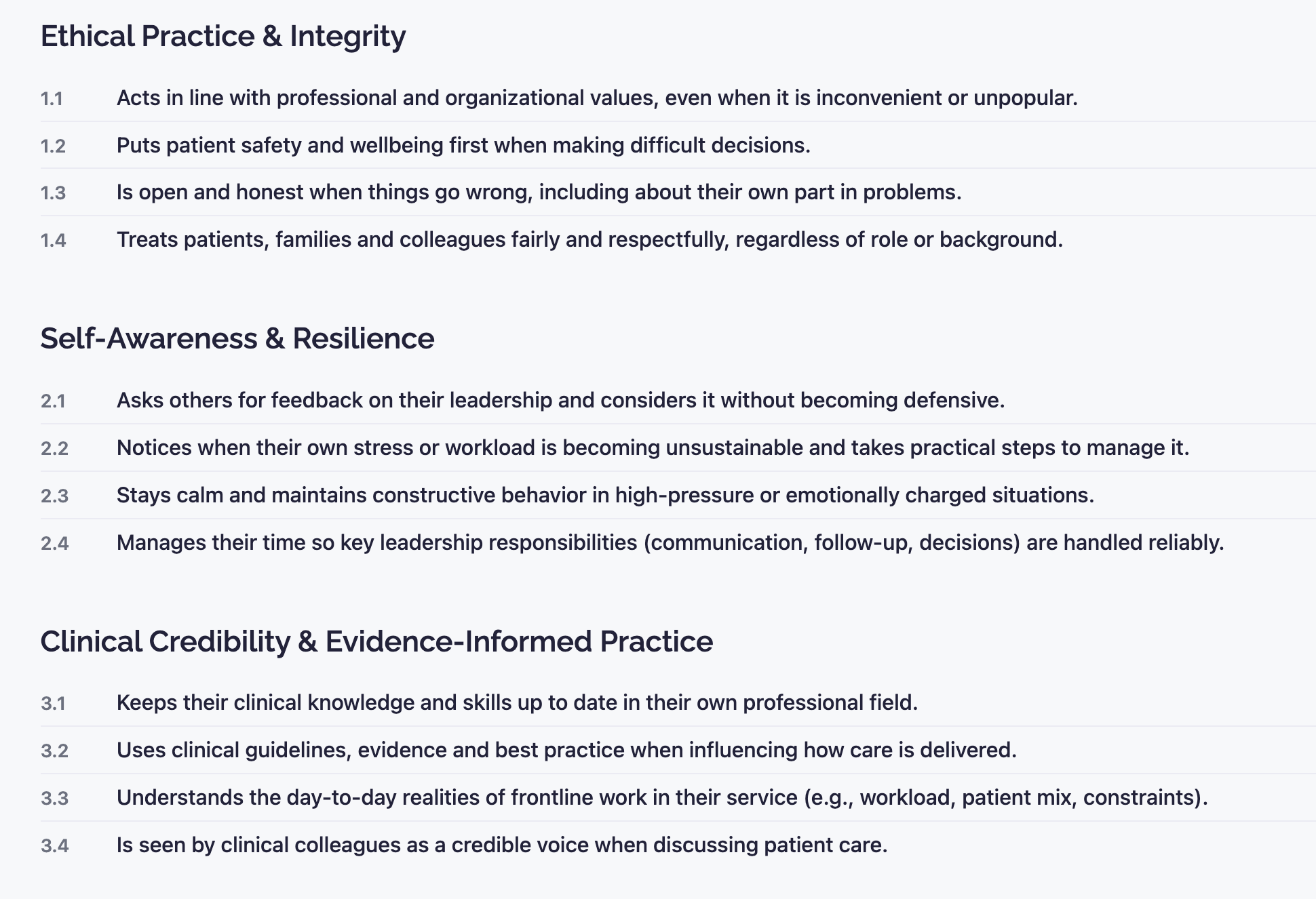
Because the competency model is profession‑neutral but clinically grounded, one tool can serve many roles: consultants, registrars with leadership duties, nurse managers, AHP leads, clinical directors, and service managers. You can lightly tailor examples or wording to each group while keeping the same core structure, which makes results comparable and development conversations much easier.
In short: our health/medical‑specific 360 respects the complexity of modern healthcare. It gives leaders a mirror that reflects their real work—caring for patients through teams and systems—and offers practical insight into how they can grow in ways that benefit both staff and patients.
Healthcare leadership isn’t just “leadership in another industry.” Medical and clinical leaders work in environments where every decision can affect patient safety, staff wellbeing, and equity of care. A leadership 360 for them should reflect that reality, not just re‑skin a corporate manager survey.
Ready to Get Started?
Take Our Healthcare Leadership 360 Assessment
Transform your leadership impact with feedback designed specifically for healthcare environments. Our medical-specific 360 assessment gives you the insights you need to strengthen patient care, support your team, and advance your leadership effectiveness.
Start Your Healthcare Leadership 360 Assessment Now →
Questions about the process? Need support with your development plan? Contact our team for guidance tailored to healthcare leadership challenges.